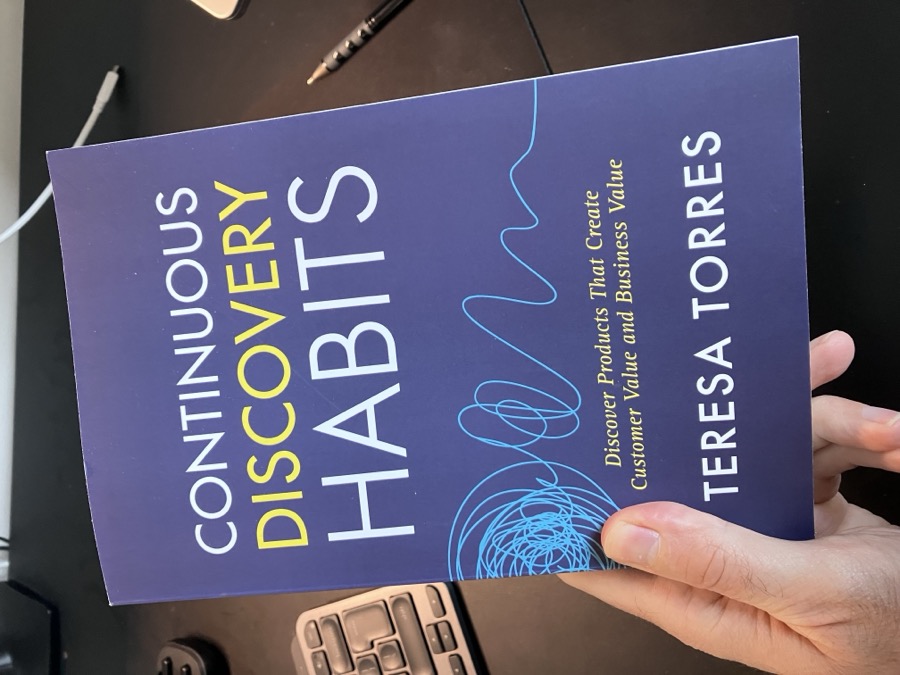
Continuous Discovery Habits
Updated 2026-04-05
Discover Products That Create Customer Value and Business Value by Teresa Torres, published in 2021. It is the key book on structured product discovery. Torres argues that discovery is not a phase but a weekly practice: at least one customer interview every week, done iteratively and systematically instead of in occasional research bursts.
Core Thesis
Teams make weak decisions because they speak to real users too rarely, and when they do, it is often too late and too unstructured. The antidote is continuity, not more effort: weekly interviews as a habit, not as a project.
Opportunity Solution Tree (OST)
This is the book’s central framework. The OST makes the relationship between outcomes, opportunities, and solutions visible:
- Outcome at the top: the measurable result the team is trying to achieve, for example higher retention
- Opportunities in the middle: customer needs, pain points, or desires distilled from interviews
- Solutions at the bottom: concrete feature ideas or experiments attached to an opportunity
The tree forces explicit linkage. Why are we building this? Which opportunity does it address? That prevents teams from optimizing the wrong opportunity.
Weekly Interviews as Practice
Torres recommends simplifying interviews radically so they become routine:
- Short sessions, around 30 minutes, instead of heavyweight studies
- Recruiting running continuously in the background
- The product trio, PM, design, engineering, listening together instead of relying on summaries
The Product Trio
PM, designer, and engineer operate as a unit in the discovery phase. Not sequentially, PM researches, design designs, engineering builds, but in parallel. Torres’ point is that early engineering input prevents teams from falling in love with ideas that were never feasible.
Assumption Testing
Before a solution gets built, the most critical assumptions should be isolated and tested as cheaply as possible. Torres distinguishes between desirability, viability, and feasibility assumptions.
Connections
- Teresa Torres - author; the book codifies her coaching practice
- Product Discovery - the book’s core topic
- Petra Wille - another coach in the discovery space; both address similar PM questions