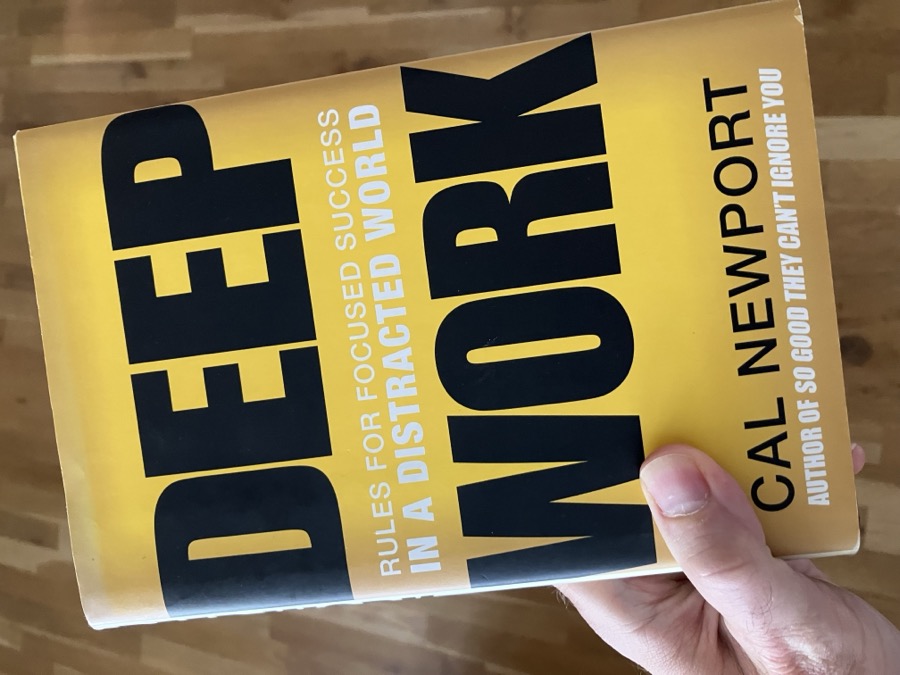
Deep Work
Updated 2026-04-09
Rules for Focused Success in a Distracted World by Cal Newport, published in 2016. The book introduced the term “Deep Work” into the productivity conversation and argues that sustained, distraction-free work on cognitively demanding tasks is both increasingly rare and increasingly valuable.
Core Thesis
Newport distinguishes between two modes of work:
- Deep Work: focused, distraction-free effort on tasks that fully stretch cognitive capacity. It creates value, improves skill, and is hard to replicate.
- Shallow Work: logistical, reactive, low-cognitive work such as email, meetings, and status updates. Easy to do, easy to imitate, and rarely high-value.
The central claim is that the ability to do Deep Work is becoming rarer because of distraction culture while becoming more valuable because knowledge work keeps getting harder. Whoever cultivates it gains an edge.
The Four Philosophies of Depth
Newport describes four ways to structure Deep Work:
- Monastic - radical isolation, almost no shallow work, common among writers or researchers in retreat
- Bimodal - clear phases of deep and shallow work, for example weeks in retreat followed by weeks in daily routine
- Rhythmic - fixed daily blocks of deep work
- Journalistic - ad hoc deep work whenever time appears, which requires strong context-switching skill
Why the Book Sticks
Deep Work gave people a name for something many knowledge workers had experienced but could not articulate: the difference between real thinking and performative busyness. That vocabulary makes it easier to argue for focus inside organizations.
The book also works as an antidote to the meeting reflex in many companies. Visibility is not proof of productivity. Real output is often invisible and happens in concentrated stretches without calendar entries.
Connections
- Cal Newport - author; Deep Work is the book that made him widely known
- Slow Productivity - Newport’s later extension from a focus principle into a broader work philosophy
- Product Builder - overlap in the ideal of concentrated, self-directed work
- First Principles Thinking - similar stance: do not optimize for speed before identifying the right work
Sources
- Cal Newport - author
- User photo of the book cover from 2026-04-09