Inspired
Updated 2026-04-06
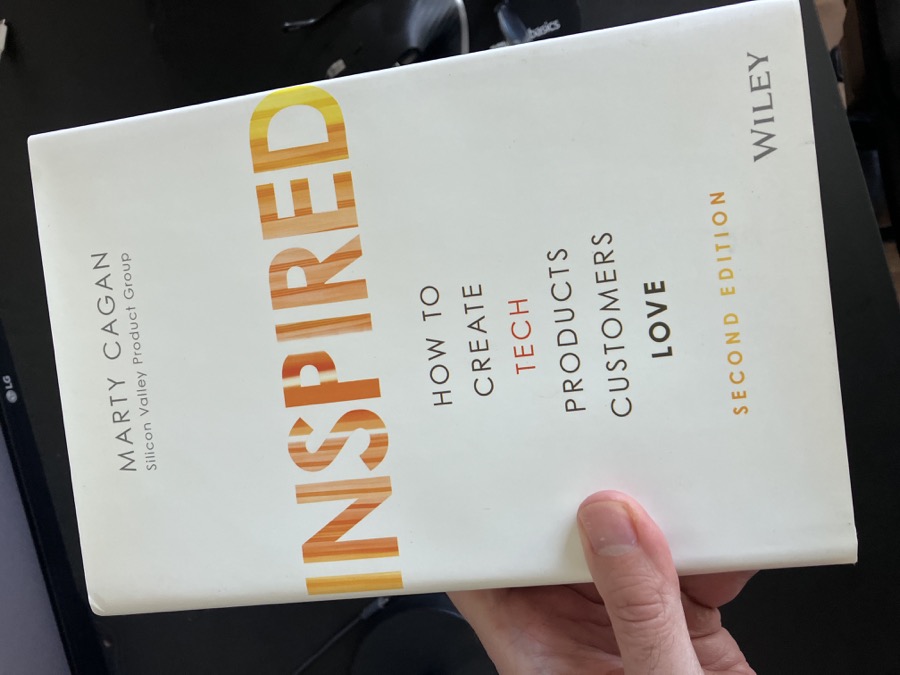
How to Create Tech Products Customers Love by Marty Cagan, here in the 2017 second edition. The book is close to the canonical operating model for modern tech product management: not ticket administration, but product work as a mix of problem understanding, judgment, and team design.
Context
Inspired matters because it defines the product-manager role not through status reporting or roadmap rituals, but through responsibility for value. Cagan argues that strong product teams do not simply ship features. They iteratively discover what actually works for users and for the business. That is why the book still functions as an antidote to feature-factory thinking.
Inside this vault it is especially relevant because several active themes connect directly to this school of thought: Product Discovery, Product Builder, and the question of how AI is changing the division of labor inside product teams. Inspired is not anti-process. It is anti-bureaucracy. The point is that lightweight process is useful when it accelerates learning instead of hiding responsibility.
Core Ideas
- Product management is not project management - Cagan draws a hard line between managing delivery plans and finding a product customers truly want that also works as a business
- Team design is part of product success - strong products come from high-functioning trios across product, design, and engineering with real autonomy
- Discovery is not an optional pre-phase - the core of product work is early testing of value, usability, technical risk, and business value before teams spend months building
- Strong product culture is a competitive advantage - empowerment, explicit ownership, and high talent density are not HR slogans but production conditions for good decisions
- Customer love is a harder test than stakeholder satisfaction - a product that looks good internally but fails to matter outside is not success in Cagan’s frame
Why the Book Sticks
Many PM books offer tips for meetings, roadmaps, or prioritization. Inspired goes deeper because it sharpens the real question: under what conditions can teams produce good products at all? That makes it feel less like a toolkit and more like a compact theory of modern product organizations.
That perspective becomes even more relevant in a phase where AI is making standard work cheaper and faster. If prototyping, documentation, and analysis get cheaper, the value of judgment, problem selection, and team quality rises. That is exactly where Cagan connects to newer themes such as Product Builder.
Connections
- Marty Cagan - the most compact introduction to his view of product teams and product responsibility
- Product Discovery - discovery is not an appendix here, but a core function of product work
- Product Builder - Cagan’s picture of teams and ownership is a useful contrast to how AI is blurring role boundaries today
- Petra Wille - Wille works on developing product leaders; Inspired describes the operating system those leaders act within
- User Story Mapping - Jeff Patton zooms into a specific work mode while Inspired provides the larger organizational frame
Sources
- User photo of the book cover from 2026-04-06