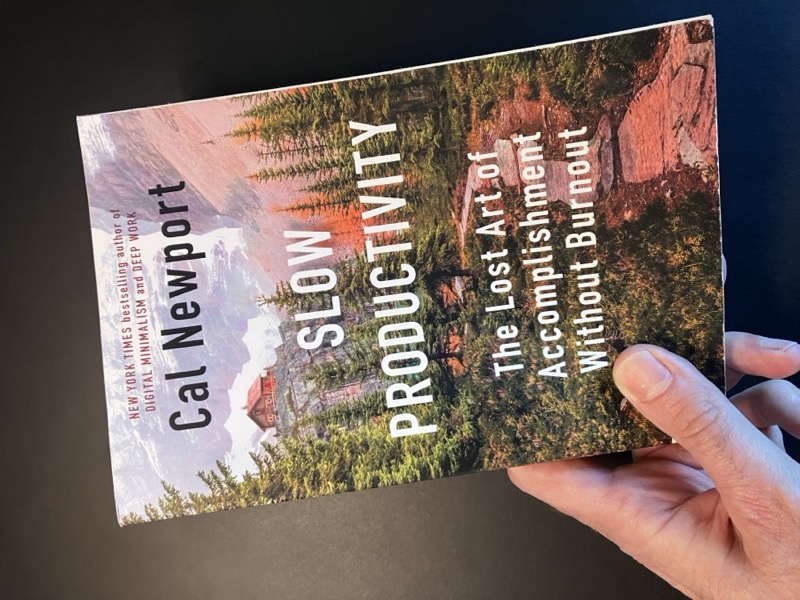
Slow Productivity
Updated 2026-04-08
The Lost Art of Accomplishment Without Burnout by Cal Newport, published in 2024. Newport, a computer-science professor and the author of Deep Work and Digital Minimalism, argues here against pseudo-productive permanent busyness and for a quieter, more sustainable form of real accomplishment.
Core Thesis
Modern knowledge workers have confused visibility with productivity: too many meetings, overloaded calendars, and permanent reachability. Newport calls this “pseudo-productivity” - performative activity that crowds out real achievement. The alternative is slow productivity: fewer things at once, done with more depth and more quality.
The Three Principles
- Do fewer things - fewer parallel commitments create more depth per task. Overload is not a virtue; it is a quality problem.
- Work at a natural pace - historical high performers such as Darwin, Newton, and Jane Austen worked in waves rather than in permanent sprint mode. Seasonality and recovery are not laziness; they are conditions for strong work.
- Obsess over quality - quality acts as a long-term filter. If you optimize for quality, you must give up some quantity, and that trade often creates independence and reputation.
Why the Book Matters
Newport is writing for knowledge workers who feel busy all the time but not especially effective. The book is not a collection of productivity hacks. It is a reframing device. The question shifts from “how do I do more?” to “what am I doing at all, and why?”
In a moment when AI tools can increase output, the questions of judgment and selection become even more important. If everything gets faster, a lot of mediocrity simply arrives sooner. Slow Productivity complements topics such as Deep Work and Product Builder: the real bottleneck is not speed, but substance.
Connections
- Deep Work - Newport’s earlier book; the focus principle underneath slow productivity
- Product Builder - overlap in how individuals and small teams create leverage through depth instead of volume
- First Principles Thinking - related impulse: question assumptions before optimizing process
Source
- User photo of the Slow Productivity book cover from 2026-04-08