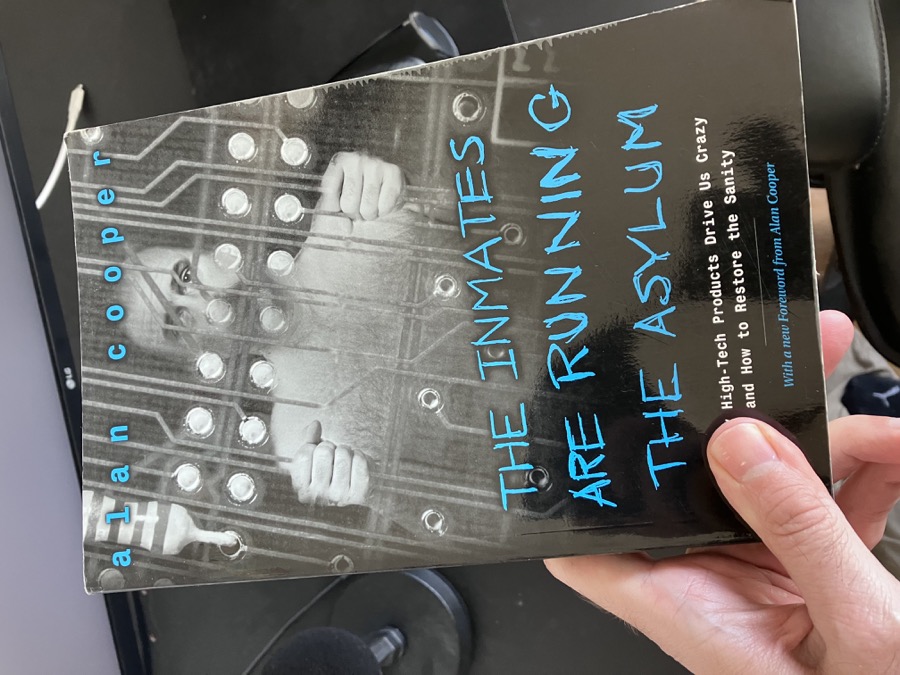
The Inmates Are Running the Asylum
Updated 2026-04-06
Why High-Tech Products Drive Us Crazy and How to Restore the Sanity by Alan Cooper is one of the early standard works in interaction design and usability-critical product thinking. The title is polemical, and that is part of why it works: Cooper attacks the habit of letting technical products be shaped by the internal logic of their builders instead of the needs of their users.
Context
The book is older than many of today’s PM and UX classics, which is exactly why it remains interesting. It was written at a moment when software and embedded systems were showing up everywhere, while interfaces still often felt like side effects of engineering decisions. Cooper’s core charge is sharp: when developers and technically driven organizations build without a serious user perspective, they produce systems that are impressive in capability and frustrating in real use.
For this wiki the book matters because it exposes a deeper root beneath Product Discovery and modern product work. Much of what later spread under labels like UX, discovery, or customer-centricity is already here in harsher form: teams do not just fail because they choose the wrong features, but because they carry the wrong mental models of their users.
Core Ideas
- Technical feasibility is not the same as usability - a product can be full of features and still deliver the wrong experience
- Developer logic systematically distorts products - builders easily confuse the product’s internal model with the user’s mental model
- Interaction design is not surface polish - good usability starts with early decisions about goals, roles, and usage context
- Complexity is often organizational failure - bad products are not only design mistakes, but mirrors of how they were built
- The user needs explicit representation in the team - without it, louder internal constraints automatically win
Why It Is Still Useful Today
The word “asylum” is intentionally exaggerated, but Cooper is naming a problem that may be even sharper in the age of AI and modern software tools. Products can be built faster than ever, but that does not automatically reduce friction for users. If prototyping becomes easier, the risk also rises that teams simply ship more internal logic instead of better experiences.
The book is therefore a valuable historical counterweight to modern builder enthusiasm. It reminds us that creator-side productivity is not a substitute for user-side understanding.
Connections
- Alan Cooper - the most direct entry into his critique of technology-centered product development
- Product Discovery - Cooper anticipates the later discovery movement: understand users and problems before building solutions
- Inspired - Cagan describes the operating model of strong product teams; Cooper supplies the sharp indictment of user-distant building
- User Story Mapping - Patton offers one practical method for keeping the user flow visible instead of collapsing into internal ticket logic
- Product Builder - the faster teams can build, the more relevant Cooper’s warning becomes
Source
- User photo of The Inmates Are Running the Asylum from 2026-04-06