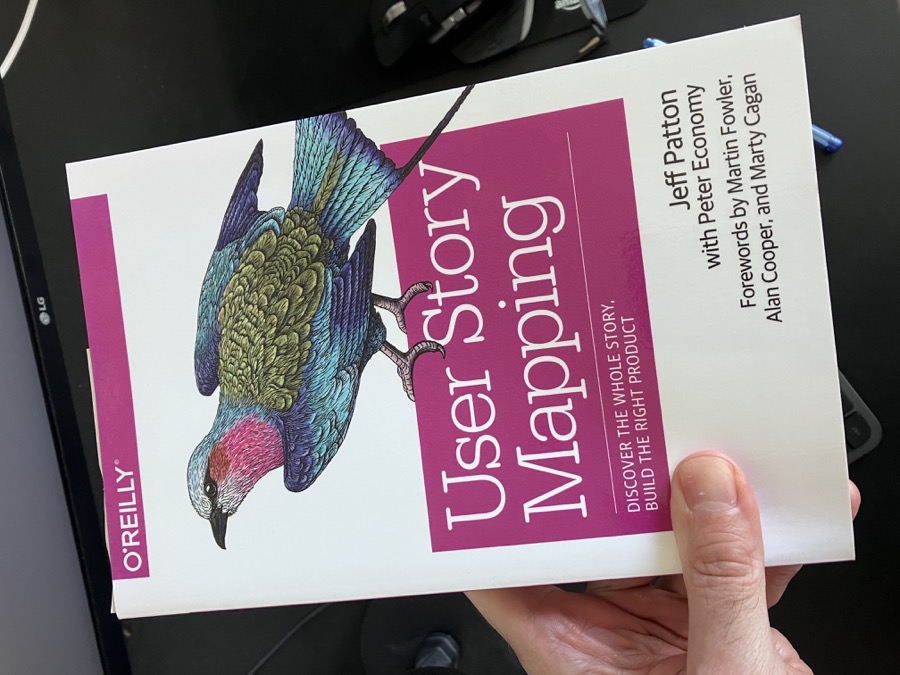
User Story Mapping
Updated 2026-04-06
Discover the Whole Story, Build the Right Product by Jeff Patton is one of the few product books that turns a concrete working technique into a better model of how teams should think. It is not mainly about backlog formatting. It is about shared understanding: teams need to see the whole user journey before they start slicing work into tickets.
Context
Story Mapping is Patton’s answer to a common failure mode in modern product teams. The backlog becomes flat, fragmented, and detached from the user’s story. Once teams prioritize isolated stories, they lose goal, sequence, dependency, and the real understanding of the problem. The result is activity without clarity.
That is why the book matters here not just as a Scrum artifact, but as a thinking tool for Product Discovery. It forces teams to talk about user flow, goals, and learning steps first, and only then about smaller work items. That is its real value: it makes better conversations visible.
Core Ideas
- The map matters more than the card - individual user stories only make sense when they are embedded in a larger user journey
- Shared understanding before documentation - story maps help teams discuss the same problem instead of hiding behind ticket text
- Build less as learning, not austerity - mapping makes it easier to see which minimum slice actually produces insight
- Releases become learning definitions - a release is not just a scope package, but a deliberately cut hypothesis about what to test next
- User stories are conversation starters - Patton pushes back against the idea that stories should behave like perfect mini-specifications
Why the Book Is Especially Useful
Many teams adopt agile rituals and then wonder why their backlogs still feel chaotic. Patton’s strength is that he does not merely sell a technique. He exposes the thinking error underneath it: breaking work down too early destroys understanding of the whole. Story Mapping is therefore less a board format than a protection against blind fragmentation.
For this wiki, the book is especially strong because it bridges discovery and delivery. It is concrete enough for team sessions and abstract enough to serve as an organizing principle.
Connections
- Jeff Patton - Story Mapping is his canonical contribution
- Product Discovery - helps teams make users, problems, and learning steps visible before implementation
- Inspired - Inspired gives the larger operating model; User Story Mapping provides one of its most practical work modes
- Product Builder - broader roles increase the value of shared understanding across functions
- Continuous Discovery Habits - both books share the idea that teams should learn continuously instead of merely managing features
Source
- User photo of the User Story Mapping book cover from 2026-04-06